Thursday, February 01, 2007

What's a better way to start the blogger year

...than with a Waleed Aly article!

The West needs to show that it is willing to abide by the popular will, writes Waleed Aly.

LET no one deny that George Bush is an optimist. Even as Iraq descends further into the quagmire of civil war, the United States President is celebrating small victories. The Iraqi people voted in three elections in 2005, he enthused in his State of the Union address last week. Yes, there have been setbacks, but "it is still within our power to shape the outcome of this battle". Let democracy triumph. Let freedom prevail. Et cetera.

Clearly, the democratisation of the Middle East has long been part of Bush's plan. For Bush, that meant trying to turn Iraq into Sweden overnight by pounding it militarily. It was a profoundly revolutionary approach, quintessentially unconservative, and ultimately doomed to the failure we now observe.

The sadly inevitable consequence has been the emergence of the thought that democratisation is simply beyond the Muslim world. It seems that when it comes to Muslim democratisation, there are those who oppose it and those who would bomb it into existence.

Neither position reflects the desires of the Muslim world itself. We have long known of the deep unpopularity of the invasion of Iraq. But we are less familiar with the attitudes revealed last week by a Gallup poll of 10 Muslim majority countries: that public sentiment across the Muslim world is firmly in favour of democracy.

The twist is that strong majorities express their democratic aspirations within an Islamic framework. The key Gallup finding is that most believe in the happy coexistence of democracy and Islamic law. They maintain that Islam should, at the very least, be a source of legislation.

This will unnerve many Western commentators whose immediate response to public religion is, for obvious reasons, often allergic. But observers of the Muslim world will be far from surprised. Election results in recent years in Egypt, Bahrain, Morocco, Pakistan, Algeria and, most infamously, the Palestinian territories, have demonstrated the willingness of Muslim-majority populations to vote for religiously based parties.

Given decades of corruption and despotism under secularists such as Saddam Hussein, and given the strong social services and anti-corruption agenda of religious parties in the Muslim world, this is perfectly understandable.

Still, one glance in the direction of Afghanistan or Iran will be enough to have many questioning the wisdom of giving democratic expression to these popular aspirations. The long-obvious, inescapable fact is that democracy in the Muslim world is unlikely to produce results entirely pleasing to Western political sensibilities. Implicit in many Western observers' objections will be the suggestion that religious parties will do considerable damage to democracy.

This is short-sighted. It would be more meaningful to consider the exact reverse: the effect democracy will have on religious polities. It is one thing to shout pious mantras of dissent from opposition; it is quite another to govern a people and then face elections. Political reality and public accountability can have a moderating effect, and governments that do not adjust risk public resentment.

It is noteworthy that support for Islamic government is highest in Egypt and Pakistan, where it does not exist, while there is increasing public dissatisfaction with self-declared Islamic governments in places such as Iran and Nigeria, which have failed to deliver freedom.

[...]

Wednesday, December 20, 2006

Joyeux Noel!

It's a French film about the Christmas Truce between French, British and German soldiers of World War I. It's simply excellent in every aspect, and i still have a big, goofy grin on my face just thinking about it. My favourite part of the film is when... ah, i won't spoil it! Nevertheless, the tagline for the film sums it up pretty well: "Without an enemy there can be no war".

Watch this film, even if it's the last thing you do! And since Joey and i have been agreeing a lot lately, the end may not be as far as we previously thought it. So do it ASAP! It might even be a nice idea to watch it on Christmas Day, for those who do and do not celebrate Christmas...

Sunday, December 10, 2006

Bono Vox Populi

I never liked Bono's music, and I always was a bit sus about his neverending supply of sunglasses and striking resemblance to Robin Williams. That hasn't changed of course, but this speech he made at the National Prayer Breakfast in Washington, D.C. earlier this year really struck a chord with me.


It's about 20 minutes long and the full transcript is available here. But for those of who can't be bothered, here are some of the best bits (well I think so anyway):

[...]

Look, whatever thoughts you have about God, who He is or if He exists, most will agree that if there is a God, He has a special place for the poor. In fact, the poor are where God lives.


Check Judaism. Check Islam. Check pretty much anyone.

I mean, God may well be with us in our mansions on the hill… I hope so. He may well be with us as in all manner of controversial stuff… maybe, maybe not… But the one thing we can all agree, all faiths and ideologies, is that God is with the vulnerable and poor.

God is in the slums, in the cardboard boxes where the poor play house… God is in the silence of a mother who has infected her child with a virus that will end both their lives… God is in the cries heard under the rubble of war… God is in the debris of wasted opportunity and lives, and God is with us if we are with them.


[...]

[Re poverty] There’s is much more to do. There’s a gigantic chasm between the scale of the emergency and the scale of the response.

And finally, it’s not about charity after all, is it? It’s about justice.

And that’s too bad.

Because you’re good at charity. Americans, like the Irish, are good at it. We like to give, and we give a lot, even those who can’t afford it.

But justice is a higher standard. Africa makes a fool of our idea of justice; it makes a farce of our idea of equality. It mocks our pieties, it doubts our concern, it questions our commitment.

6,500 Africans are still dying every day of a preventable, treatable disease, for lack of drugs we can buy at any drug store. This is not about charity, this is about Justice and Equality.

Because there's no way we can look at what’s happening in Africa and, if we're honest, conclude that deep down, we really accept that Africans are equal to us. Anywhere else in the world, we wouldn’t accept it. Look at what happened in South East Asia with the Tsunami. 150, 000 lives lost to that misnomer of all misnomers, “mother nature”. In Africa, 150,000 lives are lost every month. A tsunami every month. And it’s a completely avoidable catastrophe.


[...]

We hear that call in the ONE Campaign, a growing movement of more than two million Americans… left and right together… united in the belief that where you live should no longer determine whether you live.

Preventing the poorest of the poor from selling their products while we sing the virtues of the free market… that’s a justice issue. Holding children to ransom for the debts of their grandparents… That’s a justice issue. Withholding life-saving medicines out of deference to the Office of Patents… that’s a justice issue.


[...]

This is not a Republican idea. It is not a Democratic idea. It is not even, with all due respect, an American idea. Nor it is unique to any one faith.

Do to others as you would have them do to you.’ (Luke 6:30) Jesus says that.

‘Righteousness is this: that one should… give away wealth out of love for Him to the near of kin and the orphans and the needy and the wayfarer and the beggars and for the emancipation of the captives.’ The Koran says that. (2.177)

Thus sayeth the Lord: ‘Bring the homeless poor into the house, when you see the naked, cover him, then your light will break out like the dawn and your recovery will speedily spring fourth, then your Lord will be your rear guard.’ The jewish scripture says that. Isaiah 58 again.

[...]

I want to suggest to you today that you see the flow of effective foreign assistance as tithing…Which, to be truly meaningful, will mean an additional one percent of the federal budget tithed to the poor.

What is one percent?

One percent is not merely a number on a balance sheet.

One percent is the girl in Africa who gets to go to school, thanks to you. One percent is the AIDS patient who gets her medicine, thanks to you. One percent is the African entrepreneur who can start a small family business thanks to you. One percent is not redecorating presidential palaces or money flowing down a rat hole. This one percent is digging waterholes to provide clean water.

[...]

I truly believe that when the history books are written, our age will be remembered for three things: the war on terror, the digital revolution, and what we did—or did not to—to put the fire out in Africa.

History, like God, is watching what we do.

::::::::::::::::::::::::::::::::::::::::::::::::::::::::::

Okay, so they're more chunks then bits, I couldn't help myself.

As far as I can gather from Youtube feedback boards, I'm sure there're lots of people who have their claws out for this millionaire preaching justice, this rockstar spewing religion. Peeps, dear peeps, lay off da man! (While we're at it, leave Madonna alone for wanting to care for a child facing a high risk of death!) What Bono is saying makes sense, almost too much sense. Maybe it's time to stop worrying about why or how these words are spoken, and starting thinking about what they actually are.

I also gather that there're more than a few who are less than happy with the heavy emphasis on religion, particularly the religions of the Book. Well...get over it. Social justice IS rooted in such religions, and nothing has been said to suggest that atheists, or those of other faiths, aren't equally capable or worthy or whatever it may be. If anything, the speech implies the contrary, encourages a unified front against poverty.

So yeah, listen to what Bono is saying. It's better than anything he's ever sung.

Tuesday, December 05, 2006

The woman i want to be leader of the ALP

No one's fool: lady-in-waiting boxes clever
Michelle Grattan
December 5, 2006

[...]

[Julia] Gillard, 45, in Federal Parliament only since 1998, is ambitious, talented and, as Kevin Rudd says, endowed with a bucketful of energy. As leader, Simon Crean spotted her strengths and had her forge, as immigration spokeswoman, Labor's policy in the difficult and divisive area of asylum seekers. She did it with tact and toughness, helping to defuse the issue, which was finally put to bed under Latham.

Daughter of a migrant family from Wales, Gillard studied law, and was a senior partner in the industrial law firm Slater & Gordon before becoming chief of staff to then Victorian Opposition leader John Brumby in 1995 to '98. Her experience with state Labor gives her a point in common with Rudd, who worked for the Goss opposition and government in Queensland.

Gillard was part of the Left sub-faction led by Martin Ferguson. She became a rusted-on supporter of Crean, then of Latham. This put her at odds with Ferguson, one of the delegation who tapped Crean on the shoulder in 2003 and then voted for Beazley against Latham.

One reason Gillard disliked Rudd was that she did not believe he was loyal to Crean. Also, the two were natural future leadership rivals. The irony is that both became part of the broad destabilisation movement against Beazley and now the rivals are joined at the hip as a "team".

Gillard is disciplined, organised, and good humoured. She is the ultimate tidy-desk person. Tidy kitchen too, which, when photographed, drew criticism from some who seized on it to argue that a childless, single woman would not be accepted by the community as a leader.

She is more in sync with the style of the anal Rudd than the rather shambolic Beazley. As a political saleswoman, she is relaxed, affable, effective and uses her vivacious style to persuade. With her press secretary she often tours the parliamentary press gallery, promoting lines, sharing a joke, her hearty laugh ringing through offices.

[...]

Saturday, November 25, 2006

Words Betray Tolerance of Violence


By Waleed Aly
November 25, 2006

QUESTION: which public figure made the most contemptibly misogynist comments about rape reported in the past month?

Amid the recent furore surrounding Sheikh Taj al-Din al-Hilali, you probably missed the answer: Russian President Vladimir Putin. Putin was speaking with Israeli Prime Minister Ehud Olmert. Conversation turned to the topic of Israeli President Moshev Katsav, suspected by Israeli police of raping female employees. Putin was unaware a nearby microphone was on. He joked that Katsav was a "mighty guy". "Raped 10 women! I would never have expected that from him. He surprised us all. We all envy him."

When comments this disgusting come from the political leader of one of the world's largest nations, scandal is inevitable. The excuses were painfully familiar. "It was a joke which did not have anything to do with the official part of the talks," explained Kremlin spokesman Dmitry Peskov. It "was not addressed to journalists". Somehow, this was meant to assuage us, as if the abhorrence of Putin's remarks inhered not in their content, but the fact that journalists heard them. Still, Peskov continued: "It is not always possible to translate a Russian joke into another language in such a way that you convey its complete meaning." If so, one wonders why Putin chose to share his "humour" with an Israeli. Does Olmert possess special insight into the Russian comedic tradition?

Ultimately, we were asked to believe it was all a misunderstanding. "These words should in no way be interpreted as President Putin approving the possibility of this sort of crime," said Peskov, demanding of us new feats of interpretive gymnastics.

The defence of cross-cultural miscommunication has reached new levels of infamy after the recent the Hilali controversy. And indeed, at least in Hilali's case, it is precisely this cross-cultural element that has allowed so many commentators to adopt such a sanctimoniously outraged posture. Their rage could be unbridled because it in no way implicated them. For several commentators, Hilali's comments were immediately and exclusively co-opted into a discourse against multiculturalism. The implication is that the malady embodied in Hilali's remarks is entirely alien to us.

Sadly, this is more convenient than erudite. Only days earlier a video surfaced of a dozen Werribee schoolboys sexually assaulting a semi-naked 17-year-old girl before setting her hair on fire and urinating on her. Someone was proud enough of this production to sell copies of it for $5 in the western suburbs. The boys laughed as they did it. Two of their parents dismissed it as a bit of fun. For them, as for Putin, sexual assaults against women are a source of humour.

The facts are that the blight of misogynist thought and violence is closer to home than is comfortable. It was oft-noted during the Hilali saga that victim-blaming attitudes to rape were commonplace in Australia as recently as two decades ago — a fact evidenced by a parade of comments from judges and barristers. Certainly, it is possible that what so provoked Australians was not that such comments are threateningly foreign, but that they are menacingly familiar; that they remind us of the darker portions of our recent past.

But in truth, this is not simply a relic. Our deliverance from such attitudes on violence against women is more official, and less popular, than we might admit.

A VicHealth survey of 2000 Victorians released last month found that 40 per cent considered rape a product of men's inability to control their need for sex, while half believed, without evidence, that women falsified claims of domestic violence to gain a tactical advantage in family law disputes. Fifteen per cent still believe "women often say no to sex when they mean yes". A quarter are prepared to excuse domestic violence perpetrators if they are genuinely remorseful — which the report notes is dangerous given that domestic violence is often episodic, punctuated by remorseful moments.

Unlike the Werribee video, these attitudes cannot be quarantined to the domain of a delinquent fringe. They point to a stubborn, significant malaise in our social consciousness, and a willingness to trivialise violence against women.

Yes, other parts of the world have worse records. And yes, we have made laudable progress. Numbers of women who have suffered physical or sexual assault have declined in the past decade. Nearly everyone now accepts domestic violence is a crime. Those who believe that "women who are raped often ask for it" are now only 6 per cent. Ten years ago, they were 15. But continued progress is only possible when we acknowledge that problems remain. And they do.

Today is the day to recognise this. White Ribbon Day, the UN-declared day for the elimination of violence against women, is about keeping this global problem in our consciousness. One might have hoped the stream of news over the past month would mean we would not needed reminding. Popular attitudes suggest we do.

Waleed Aly is a White Ribbon Day ambassador.

Saturday, November 04, 2006

A cool band...

John Butler Trio. Australian music at its best methinks...

Zebra (live):


Something's gotta give (live):


Home is where the heart is (close to being my favourite song):


Australian bands rock. We need more of 'em (the good ones, not the shit ones like AC/DC)!

Tuesday, October 24, 2006

Rock And Roll Over


With everyone from The Veronicas to Robbie Williams claiming rock'n'roll cred, is rock in danger of becoming just another adjective?

It doesn't take much to be "rock" these days. Once upon a time it took a modicum of edge, perhaps a captivating stage persona, sometimes you even had to play rock'n'roll to be rock!

Now, all you have to do is wear a certain t-shirt, mix some Boss overdrive in with your chintzy pop, and/or pose with a guitar, and bingo! Instant rock.

Read more...

My favourite part of the article was this quote:

If the issue had been called "Women in Music". or maybe "Some Cute Girls with Top 10 Records out Right Now". I would have no beef with it. Corny as it may sound, ROCK is something which is still meaningful and even sacred to some of us. Use the word "rock" in bold letters next to a picture of Britney F--king Spears, and you're turning your whole publication into a joke... and an offensive joke at that.

So f--king true!

Sunday, October 22, 2006

...And a good politician says goodbye


I don't think Joey (or Nur for that matter) care about this, but i am so incrediably disillusioned by Natasha Stott Despoja's decision to quit federal politics. She was the one who really got me interested in Australian politics, not to mention my favourite politician ... and i don't know what else to say! I don't think i'm going to get over this any time soon. And Joey shall hear me whine about it hereafter.

Stott Despoja set to quit
October 22, 2006

Former Australian Democrats leader, Senator Natasha Stott Despoja, has announced she will quit federal politics when her current term ends in 2008.

Senator Stott Despoja told reporters in Adelaide today she would not be nominating for the senate ticket for the next federal election, due by next year.

[...]

Senator Stott Despoja said she would continue to pursue social justice and human rights issues "in ways that enable me to spend more time with my son Conrad, especially when he reaches school age."

"The prospect of not being a legislator is heartbreaking for me: I love the cut and thrust of the parliament, the opportunities to change laws and therefore lives for the better.

"This passion has sustained me even through tough political and personal times."

Senator Stott Despoja said her commitment to the Democrats was unshakeable and she believed they could retain her senate position at the next election.

She said there was a lot more she wanted to achieve on behalf of the Democrats before her term was completed, including the passage of advanced stem cell research laws, national paid maternity leave, and greater investment in education.

The senator, who was close to tears during her announcement, did not rule out a return to parliament in the future.

She did, however, rule out any involvement in state parliament in South Australia.

- AAP

Monday, October 09, 2006

Tales from the toilet block


I know this is probably going to sound very strange, but one of the most interesting parts of my day at university is visiting the toilets in the Baillieu Library. I love the Baillieu. It’s weird I know, to love a library. But I feel like it’s my second home. It’s filled with science students, architecture students, engineering students…you name it. But mostly it’s filled with arts students. Loud, messy arts students! I guess that’s why there’s no one telling you to “shush” in the Baillieu. It’s more likely that the person next to you is making more noise than what’s heard on the 4th floor of the law building in one day.

But you know what the best part of the Baillieu is? The fact that we can take in, wait for it……FOOD! Need I say more?

Anyhow, here’s some stuff I read on the toilet walls. There’s also quite a heated pen-discussion going on on the walls of one of the cubicles about Descartes and what he really meant with cogito ergo sum. Maybe I’ll put that up one day!


Hah! Fat chance. I hate Descartes. :)


You cannot go through the front door with a red fist. You must change the world through the back door, with a suit and a better plan.


Today I wonder:

What for?

Freedom lives in constraint.

Sunday, October 08, 2006

Aussie Aussie Oi


Samuel Johnson famously declared that patriotism was the last refuge of the scoundrel, but the American satirist Ambrose Bierce may have been closer to the mark when he said that it was the first. In any case, the fog of patriotic fervour now lies so heavy on the Australian political landscape that it is necessary to clear some of it away lest we lose direction entirely.

Attachment to the good habits and institutions of one's country and a modest pride in the genuine achievements of one's co-nationals is a commendable attitude, capable of forging ties and cementing community feeling. But patriotism has a strong tendency to go beyond this. The slogan, "My country, right or wrong" is palpably absurd, but the more seductive, though equally foolish, idea is that my country can actually do no wrong, or, at any rate, no serious wrong. The emotions of patriotism all too often blind us to the moral crimes and follies that "we" have committed and can again commit. When this is combined with the political advantages of populism, the mixture can be lethal. It is not only scoundrels who misuse patriotism; the foolish and opportunistic also do it.

Our politicians are falling over themselves to reach the peak of Patriot Hill. They vie with each other to make new and more dramatic proposals for pulling the rest of us into line with some opaque vision of Australian values. The proposals range from the conspicuously silly, such a Kim Beazley's visa pledge to Aussie values for tourists to the downright unpleasant, such as Andrew Robb's proposal to force migrants to wait four years for citizenship instead of the present two. There is even a whiff of it in Julie Bishop's call for a common national school curriculum designed to fend off Marxist, feminist and even (God help us!) Maoist interpretations apparently being foisted on our unsuspecting Aussie kids by ideologues in state education bureaucracies.

Much of this combines exaggerated fear with extravagant attachment to a comforting fantasy of a stereotypical Australia. The fantasy is supposed to protect us from the fear. The fear itself is partly a genuine if overwrought fear of terrorist acts, and partly a formless dread of unusual foreigners, especially, nowadays, Muslims.

I remember when Australian patriotism used to be a quiet and modest affair. The 1950s that our Prime Minister is so fond of was actually a time when loud affectations of "Aussie values", condemnations of "anti-Australian behaviour", and indulgence in flag-worship would have been greeted with astonishment and scorn. I can only hope that some of that earthy, cynical realism remains in our make-up, but decades of exploitative advertising ("C'mon Aussie, c'mon") and imitation of the most sentimental elements in American culture have undoubtedly had their effect. The idea that respect for law, regard for justice ("fair go"), and concern for women's rights somehow flourish distinctively here ("Aussie values") and languish everywhere else is of course nonsense, but that is the impression regularly conveyed by many of our political leaders, and reinforced in much of the media.

[...]

Thursday, October 05, 2006

Saturday, September 30, 2006

Finally... i know how to upload!!!

It's a bit (not suprisingly) delayed, but here is some footage from Matisyahu's gig on July 25th, 2006. I had the absolutely pleasure of being there, even if it was with my (un-kewl) brother. Joey was not so fortunate, which is really why i recorded this footage in the first place ('cause i'm that nice). If she had listened to me and used a fake id! Kids these days are so responsible.

Anyhow... enjoy! I have a few more full songs to upload, but i need to figure out how to cut then down first (which may/may not take about a year).

Indestructible...


Great guitar solo (even if it is badly recorded, you get the idea)...

Wednesday, September 27, 2006

Sick of Politics

So let's have some poetry!

If
By Rudyard Kipling

If you can keep your head when all about you
Are losing theirs and blaming it on you
If you can trust yourself when all men doubt you
But make allowance for their doubting too
If you can wait and not be tired by waiting
Or being lied about, don’t deal in lies
Or being hated, don’t give way to hating
And yet don’t look too good, nor talk too wise.

If you can dream–and not make dreams your master
If you can think –and not make thoughts your aim
If you can meet with Triumph and Disaster
And treat those two impostors just the same
If you can bear to hear the truth you’ve spoken
Twisted by knaves to make a trap by fools
Or watch the things you gave your life to, broken
And stoop and build ‘em up with worn out tools

If you can make one heap of all your winnings
And risk it on one turn of pitch and toss
And lose and start again at your beginnings
And never breathe a word about your loss
If you can force your heart and nerve and sinew
To serve your turn long after you are gone
And so hold on when there’s nothing in you
Except the will that says to them: Hold on!

If you can talk with crowds and keep our virtue
Or walk with kings, nor lose the common touch
If neither foes, nor loving friends can hurt you
If all men count with you, but none too much
If you can fill the unforgiving minute
With sixty seconds worth of distance run
Yours is the earth and everything that is in it
And, which is more, you’ll be a man, my son.

:::::::::::::::::::::::::::::::::::::::::::::::::::::::::::::::::::::::

Bit male-centric. Nonetheless nonetheless. I like.

(The formatting is gross, I know. But I can't help it!)

Monday, September 18, 2006

Subtle scholar, but what an inept politician

I wish these guys would get a clue and read this article...

by Waleed Aly

September 18, 2006

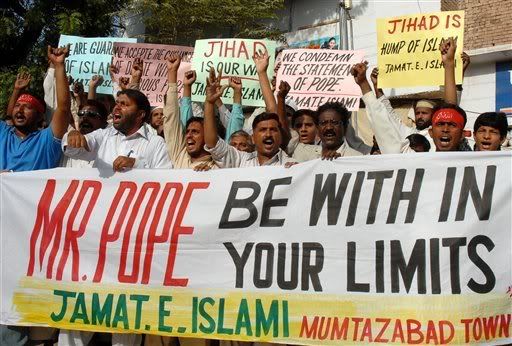
The Pope should mind his words. So should some of his Muslim critics.

LET me get this straight. Pope Benedict XVI quotes the 14th century Byzantine Emperor Manuel II Paleologus asserting before a Persian Islamic scholar that the prophet Muhammad brought nothing new to the world except things "evil and inhuman, such as his command to spread by the sword the faith he preached". Some Muslims clearly interpret Benedict to be quoting Manuel with approval, and take offence at the suggestion that Islam is inherently violent. The response is to bomb five churches in the West Bank, and attack the door of another in Basra. In India, angry mobs burn effigies of Pope Benedict. In Somalia, Sheikh Abu Bakr Hassan Malin urges Muslims to "hunt down" the Pope and kill him, while an armed Iraqi group threatens to carry out attacks against Rome and the Vatican.

There. That'll show them for calling us violent.

Meanwhile, other commentators seem to be vying to be most hysterical. Libya's General Instance of Religious Affairs thinks Benedict's "insult … pushes us back to the era of crusades against Muslims led by Western political and religious leaders". And a member of the ruling party in Turkey has placed Benedict "in the same category as leaders like Hitler and Mussolini", in what must surely be an insult to those who suffered under them.

Closer to home, Muslim Community Reference Group chairman Ameer Ali cautioned Benedict to "behave like (his predecessor) John Paul II, not Urban II (who launched the Crusades)", while Taj al-Din al-Hilali declared startlingly that the Pope "doesn't have the qualities or good grasp of Christian character or knowledge". It's fair to say perspective has deserted us.

Parallels with February's Danish cartoon saga are begging to be drawn. As Saudi Arabia, Iran, Libya and Syria did with Denmark, Morocco has now withdrawn its ambassador from the Vatican. Egypt and Turkey called for an apology. Indeed, one expert has suggested Morocco's

decision may have been a tactic to prevent a wave of street protests similar to those that stunned the world in February. There is an awful sense of history repeating: a provocative gesture triggers an overblown response of surreal imbecility.

But this is not the same as the Danish catastrophe. On that occasion, the cartoons' publication was an act calculated specifically to offend Muslim sensibilities. The reaction was irredeemably contemptible, but the sense of offence was justified.

Pope Benedict's speech was an academic address at a German university on an esoteric theological theme that had nothing to do with affronting Muslims. The apparently offending remarks were almost a footnote to the discussion. The contrast is manifestly stark.

But it seems some elements in the Muslim world are looking avidly for something to offend them. Meanwhile, governments looking to boost their Islamic credentials are only too happy to seize on this, or nurture it, for their own political advantage. At some point, the Muslim world has to gain control of itself. Presently, its most vocal elements are so disastrously reactionary, and therefore so easily manipulable.

Here, the vociferous protests came from people who, quite clearly, have not bothered to read Benedict's speech. Worse, some (like al-Hilali and Ameer Ali) themselves regularly complain of being quoted incorrectly and out of context. Had such critics done their homework, they would have noted Benedict's description of Manuel II's "startling brusqueness". Manuel's point was that violent doctrine could not come from God because missionary violence is contrary to rationality. Benedict's point was a subtle one: that Manuel draws a positive link between religious truth and reason. This was the central theme of the Pope's address. He was silent on Manuel's attitude to Islam because it was beside the point he was making. Clearly, Manuel II was not a fan of the prophet Muhammad. But that does not mean Benedict isn't either.

The trouble with being the Pope is that you are simultaneously a theologian and a politician. Theological discourse is regularly nuanced and esoteric. Political discourse

is not. Turkish Prime Minister Tayyip Erdogan said "the Pope spoke like a politician rather than as a man of religion", but the truth is the exact opposite. In theological terms, Benedict chose an example well suited to his narrow argument.

In political terms, his choice was poor. He was naive not to recognise how offensively it would translate into the crudeness of the public conversation, and should at least have made clear that he was not endorsing Manuel II's words.

I happen to think Manuel had a shoddy grasp of Islamic theology. Indeed, the Islamic tradition would have much to contribute to the theme of Benedict's lecture. While medieval Christendom fought science stridently, the relationship between faith and reason in traditional Islam was highly convivial.

That's why I would be interested to have heard how the Persian scholar responded to Manuel's argument. I'm fairly certain, though, he wouldn't have called on Muslim hordes to hunt down Manuel and kill him.

Waleed Aly is an Islamic Council of Victoria director.

Thursday, September 14, 2006

The poisonous political cycle that harms us all

September 9, 2006

There is something frightening about two sides fighting a war each claims the other started., writes Waleed Aly.


ON THE first anniversary of the September 11 attacks, Britain's most vile terror-loving organisation, al-Muhajiroun, held a celebratory conference. Members gathered to recall how "magnificently" the twin towers were reduced to rubble.

Conference excerpts were replayed on radio after the London bombings last year. A spokesman said it was perfectly acceptable in Islam to kill civilians. Naturally, this sickened me as a person and insulted me as a Muslim. But it did not disturb me as much as I expected: his ranting was so maniacal it didn't quite seem real.

But then he said something that jolted me rudely back to reality. Islam does not permit one to start wars, he said, but September 11 was not the start. It was a response to decades of aggression. He insisted that he didn't start this war, but he was intent on supporting those who would finish it.

This statement was so disturbing because it was so familiar. It is precisely what we hear from our political leaders every time a terrorist atrocity occurs, precisely the sort of justification put forth before, and relentlessly repeated since, the disaster of Iraq. There is something frightening about two sides fighting a war each claims the other started, and each claims it now must finish.

Initial Western political responses to September 11 were staggeringly reductionist, triumphalist, even self-congratulatory. George Bush spoke like a comic book superhero by framing the world in terms of good and evil. Western societies were terror targets because they were so thoroughly good. We are despised because we are so virtuous.

In fairness, these responses are understandable in the emotional whirlwinds of tragedy. They give reassurance at a time of raw pain. But eventually, they must give way to more introspective nuance. And indeed, here, the Australian Government should be given credit: it has belatedly incorporated job, recreation and education initiatives into its security strategy, which at least shows a recognition that terrorism has important social dimensions.

But still, five years on, Western governments have, at least publicly, exhibited a stubborn blind spot when it comes to the impact of their own foreign policy. They have held fast to the implausible proposition that however many innocent people we kill as "collateral damage", whether by invasion, or as was the case earlier in Iraq, via sanctions that saw 500,000 children die, this in no way aids the terrorists' cause.

This ignores that Western foreign policy has always been a central plank in terrorists' discourse. Typical were the words of al-Qaeda spokesman Sulayman Abu Ghaith following the September 11 attacks: "The number killed in the World Trade Centre and the Pentagon … is only a tiny number of those killed in Palestine, Somalia, the Sudan, the Philippines, Bosnia, Kashmir, Chechnya and Afghanistan. We have not yet arrived at equivalency with them; thus we have the right to kill 4 million Americans, among them 1 million children." Morally repugnant indeed. Historically nonsensical. But driven by vengeance for suffering perceived to be inflicted by, or through, the West. The 9/11 Commission Report in the US explained as much. Western polities choose to ignore it.

Thus, the circle of blame completes itself. If terrorist ideologues are so concerned about oppression of Muslims, they might begin with the fact that most of their victims have been Muslims. They might turn attention to Sudan, where Muslims are killing and raping each other in numbers that make all else fade into insignificance. Yet until Western forces intervene, this slaughter is of little consequence to terrorists. Apparently, what matters is not who is killed, but who does the killing. So much for being vanguards of justice.

This deep terrorist hypocrisy does reveal a strong ideological element. But our politicians' tendency to pretend that past colonisation of Muslim lands and the present invasion and occupation of Iraq is irrelevant, is wilfully oblivious to the obvious. The Australian public intuit this. Well over two years ago, an opinion poll found two-thirds thought our role in Iraq would make a terrorist attack here more likely. And that was before Iraq's descent into radicalising catastrophe. It seems public wisdom trumps political rhetoric.

Five years after it all began, can we please end the poisonous political cycle? Can we admit the damage we have done and still do in the Muslim world? Can we realise that while this can never justify terrorism, it aids terrorist recruitment? Can Muslims admit that terrorism does not restore balance or return honour, but inflicts continuing oppression on innocent Muslims? I suspect, deep down, we all recognise these contradictions, but cannot find the political courage to admit them. How catastrophic that humanity uses the suffering of innocents not to reflect inwardly but to rage outwardly, to justify its next moral transgression. What an insult to those slaughtered. What a disaster for all of us if history repeats.

Waleed Aly is an Islamic Council of Victoria director.

Sunday, August 27, 2006

A bit excessive?

Call me soft if you will: i can't help but think that 20 years behind bars is a little excessive considering the guy didn't actually do anything. Seriously, who hasn't thought about strangling Andrew Bolt, Peter Costello and John Howard?

Bomb plot man gets 20 years
Kenneth Nguyen and Lisa Allan
August 24, 2006

THE 20-year jail term handed to a man who wanted to blow up Australia's electricity grid was a sign of how tough the courts will be on terror-related crimes, legal experts say.

Faheem Khalid Lodhi, 36, will spend about as much time in jail as an average murder sentence after he was caught in early stages of a criminal plan that a judge conceded lacked viability.

The sentence will come as a relief to the Federal Government, after the first person jailed under its tough anti-terror laws, Joseph "Jihad Jack" Thomas, had his conviction quashed last week.

Lodhi showed no emotion yesterday as he was sentenced in the NSW Supreme Court.

Lodhi, the first person convicted under the new laws of planning a terror attack on Australian soil, had been "essentially informed by the concept of violent jihad and the glorification of Muslim heroes who have fought and died for jihad", Justice Anthony Whealy said.

The court had heard previously that the Pakistani-born architect, who lived in the Sydney suburb of Lakemba, used a false name to obtain two maps of the national
electricity grid in October 2003.

Lodhi had also sought information from a company about the availability of chemicals to manufacture explosives (which he never obtained), and had written a 15-page terrorist manual with recipes and instructions on bomb-making, hand grenades, petrol bombs and poisons.

Lodhi was linked to French terrorist suspect Willie Brigitte, whom he picked up from Sydney airport in May 2003. Justice Whealy said Lodhi and Brigitte (who was deported later that year) had a "joint interest in contemplating and discussing the possibility of some type of terrorist activity in Australia".

Justice Whealy said although Lodhi's plot was thwarted at a very early stage and there was a "general lack of viability and sophistication" in his actions, it had the potential to have an impact on Australia's stability.

Had the attack been carried out [but it wasn't!], it "would instil terror into members of the public so that they could never again feel free from the threat of bombing attacks within Australia".

The judge added: "One has only to think of the consequences on the national psyche of a tragedy such as the Port Arthur massacre to realise how a major terrorist bombing would or could impact on the security, the stability and wellbeing of the citizens of this country."

Lodhi will serve a minimum 15 years for acting in preparation for a terrorist attack by seeking information about chemicals capable of making explosives.

[....]

Thursday, August 17, 2006

How do you say "yobbo" in Vietnamese?

By Sam de Brito
August 17, 2006

Imagine walking into a newsagency and some crabby, 'old-school' Aussie is getting stroppy* with the elderly Chinese owner who's saying, "No siss for dollah." The Aussie, who's probably two generations out of Manchester, is shaking his head dramatically, like the Chinese bloke is a retard. "Just give me me f**kin' scratchies will ya?" he says, abandoning any pretence of politeness, but really he's thinking: "Learn to speak English." That's when the Chinese bloke's 18-year-old son appears out of the back room and strolls up in his boardshorts. In a perfect Australian twang he says: "You get six for ten dollars, mate, that's what me old man's tryin' to tell ya. He doesn't wannna rip you off"…

Now commeth the change.

The 'Aussie's' demeanour immediately becomes solicitous because he's dealing with someone whose English is just as good as his.

Why?

It's so much harder to be racist when the focus of your contempt speaks with the same accent you do.

This scene is being repeated in bakeries, restaurants and dry cleaners all over the country.

It happened to the Greeks and Italians and Lebanese; now a whole generation of Vietnamese and Cambodians, Thais and Chinese are growing up with yobbo accents you could beat a Pommie backpacker unconscious with.

We're now at the point where the Australian national cuisine has gone from being sweet and sour pork at the local Chinese restaurant to laksa at the Thai joint up the road (even though it's a Malaysian dish).

One of my oldest mates, Pete, was born in Korea and moved here when he was five-years-old. It was a tough gig for him surfing our local break.

Kids too young to have seen his head before in the line-up would drop-in on him mercilessly, burning him because they thought he was just another Japanese tourist out here to spend his rich industrialist dad's money.

That's until Pete would do a perfect reo off the offending grom's head and yell at him in plain, ocker English: "Don't drop in on me again, you little kook."

The expression on the kid's face was always worth its weight in Four 'n' Twenty pies.

Peter now lives up the coast and the first time he went to the local RSL, it was like the new gunslinger had come to town. The music stopped and all the heads at the card machines stopped to turn and stare.

"No one said anything, but there were some heavy looks," said another one of my mates, who lives up north as well.

Gradually, the cement-spattered tradies and purple-faced pissheads realised Pete was in the TAB more than them. Every time they'd look up at Sky Channel to watch the seventh at Warrnambool, there would be the Asian bloke with his schooner, laying the whip into his imaginary mount.

When it came in at 11 to 1, they'd scream for joy and realise they were both on the same horse and smile at each other, because, Jeez, we both just won four hundred on that thing.

Pete would come in for a New some days and they'd nod their heads, just to be polite and maybe ask him what he was on, to see what the Asian bloke would be backing.

Every now and then they'd mention the weather and Pete'd say something about the surf being good at such and such a reef and they'd wonder how the hell he knew that it worked best on a south-east swell.

Then maybe fishing would come up and Peter would tell them about the bream he caught at such and such a beach or the smoko he got off this tiler at the pub and, well, it's hard to hate a bloke who likes fishing and a smoke and surfing and a beer and a punt, isn't it?

I don't know about you, but I am particularly enjoying seeing the new generation of Asian-Australians coming to the fore, with their perfect English and understanding of 'our' ways.

Earlier this year, at a suburban bowling club, I saw an Aussie of Asian appearance carrying two jugs of beer in one hand and four empty schooners glasses snaked in the other.

One of the guys I was with yelled at him: "nice effort, mate," and the bloke just nodded.

Made me want to sing Waltzing Matilda.

*Stroppy: Easily offended or annoyed. Ill-tempered or belligerent.

:::::::::::::::::::::::::::::::::::::::::::::::::::::::::::::::::::::::::::::::::::

Hilarious post from Sam de Brito's "All Men Are Liars (except Sam de Brito)" blog. Well methinks anyway. The man's observations are so relatable. Couple of people come to mind...

However, he definitely portrays the phenomenon as positive. That I disagree with - assimilation ring a bell? A reader comments that it is less a matter of assimilation and more a matter of humanism - "if you humanise whom you perceive to be the object of your hatred, you become no longer capable of maintaining towards them the same degree of irrational animosity."

Well, if you need to hear an Aussie accent to realize the one talking to you is human, let's put this in words you'll listen to - Myyte, Oi think men-tul ray-ta-day-shin is more your problem.

Wednesday, August 16, 2006

Disclaimer

I am the type of person who likes to get differing, and often opposing, perspectives on pretty much anything – political or not. This is why I read a variety of newspapers and magazines. I have however, been very disheartened and disappointed with The Australian, which led me to remove the link to it off our “News” sidebar. I did not want it there simply because I did not share the views expressed by the editors, and found that even the ‘objective news’ articles in the paper were in fact quite biased and somewhat misinformed. Recently, such behavior has become more evident - I guess they weren’t trying to hide it.

Nevertheless, the link is back up on the sidebar. I still read The Australian, even if I do not share their views. And I guess the best way to understand who has an agenda and who does not, is by reading everything and anything. I just hope by the end of all that reading you’d be left with some truth and sense.

Or you could just read a bunch of Waleed Aly articles.

Monday, July 31, 2006

War has Lured Bigots out into the Open

By Waleed Aly
July 31, 2006

The bombardment of Lebanon has spawned a humanitarian crisis. Hundreds have been killed. Well over half a million have been displaced [...]

Only last week, 25,000 Australian citizens were caught in the middle of this military bombardment...In such a situation, the only relevant question for the Australian Government is how, not if, to evacuate them. And indeed...this was precisely the Federal Government's response. Simple, really.

How then, did an unambiguously tragic humanitarian mess...give life to what the Prime Minister last week acknowledged was an emerging debate on dual citizenship? Suddenly...Western Australian MP Wilson Tuckey is arguing that dual citizenship should be abolished; that people should choose one or the other. [...]

This absurdity stems from the fact that, at least according to an odious array of letter writers, talkback radio callers and newspaper columnists, these Australians trapped in Lebanon were not Australian after all. They were Lebanese-Australians. They held Lebanese passports, too. They even lived in Lebanon. On this basis, faced with Australian citizens in grave peril, this group's rhetorical response was not to advocate for their rescue, but to question their loyalty.

In so doing, they created a new category of person: the pseudo-citizen to whom we owe nothing or at least not a rescue mission from a war zone. After all, that costs taxpayers' money. Why should we spend it on saving their lives?

It is perhaps the most disgusting argument I've heard over the course of a decidedly ugly fortnight. One might have thought that money spent saving...lives...could scarcely be called wasted. It is irredeemably repugnant to argue that people can be undeserving of the Australian Government's help simply because they hold another passport and spend extended periods of time overseas.

It is tempting to say this discourse merely reflects a recently emerging narrative of Australian nationalism. Several federal politicians and business leaders have sounded off about loyalty to Australia in recent...times of insecurity and stress. [...]

But it seems clear now that there is something deeper at play here. Last Wednesday, Assaf Namer, an Australian citizen fighting with the Israeli army in Lebanon, was killed in a Hezbollah ambush in Bint Jbeil...The public testimonials to a man who loved Australia and had Australia in his heart are plentiful.

We have heard how he planned to return to Sydney, marry his girlfriend and spend his time between Australia and Israel. We have heard of his parents' anxiety when he told them of his decision to volunteer for military service. What we have not heard is anyone...questioning his credentials as an Australian for his demonstrably zealous loyalty to a foreign state.

Similarly, when Israel began pounding Lebanon, putting at risk the lives of thousands of Australian citizens, I don't recall pro-Israeli spokespeople being bombarded with questions about whether their primary loyalty was to Israel or their fellow Australian citizens.

Let me be abundantly clear: had such questions been asked, I would have found them repulsive. [...] They exhibit a grotesque myopia, and fail to acknowledge that as Australians we are still connected...the world around us. But, if the emerging philosophy of vehement nationalism is truly about nothing more than total and undivided loyalty to Australia, it is precisely the kind of question that was begging to be asked.

And if Iran was attacking England, leaving many London-based Australian citizens stranded, it surely would have been. And British-Australians (the largest group of Australians with dual citizenship) would, rightly, be unquestionably Australian.

Instead, it was only endangered Australian-Lebanese civilians who were required to justify their Australian existence. Perhaps here, it becomes clear that the loyalty question is about something else.

Perhaps the objection is not purely to what the Prime Minister calls hyphenated Australians. At least for some commentators, it would seem that some hyphens are more acceptable than others. It is not the hyphen's mere existence that is of concern, but what is on either side of it.

Nationalism, though sometimes harmless, has occasionally provided cover for bigotry. It is difficult to avoid the conclusion that in this instance, that cover has been blown.

Waleed Aly is an executive committee member of the Islamic Council of Victoria.

:::::::::::::::::::::::::::::::::::::::::::::::::::::::::::::::::::::::::::::

Yes, another article by Waleed Aly. It can't be helped, the man simply talks too much sense.

Sunday, July 30, 2006

A view from Medecins Sans Frontiers

Lebanon: Aid moved with difficulty and access hampered

There have been violations of the most essential humanitarian obligations, including the destruction of trucks loaded with aid and the targeting of fleeing civilians by bombing. Aid workers have also been subject to machine-gun fire. It is almost impossible to gain access to civilians in the most exposed areas.

As four Médecins Sans Frontières (MSF) teams continue to evaluate needs in different areas of the country (Beirut, Jezzine, Saida, and Tyre), an initial delivery of 85 tons of supplies is on its way to Lebanon. This first round of distributions is intended for the displaced persons who have fled the fighting.

Pierre Salignon, MSF's General Director in France, provides an initial view of the situation in the field and the problems the teams face.

What is the situation of the Lebanese population?

This is a serious crisis. As part of the evaluations that our teams have conducted in the field over the last few days, they have observed that the population is in a very fragile situation.

The human cost of the war between the Israeli Army and the Hezbollah militia fighters is high. The bombings have not spared civilians or the infrastructure required for their survival. It is revolting. There are hundreds of wounded and more than 300 dead.

Massive numbers of people have been displaced from the bombed areas, with authorities estimating their numbers at more than 500,000. The poorest among them have lost everything and are completely destitute. They have no water, no items essential for daily life (mattresses, blankets, soap) and some have no food. They have no resources and can purchase nothing. They are totally dependent on the aid provided by their families and the local governments in the areas where they are sheltering.

How is the aid being organized? What problems are the teams facing?

At this stage, the aid organized by our Lebanese colleagues has been responsible for avoiding a medical catastrophe. I want to emphasize that. From the first days of the war, the Lebanese medical authorities and organizations have been the ones to take on the bulk of the aid effort.

But that won't continue. Local capacity is dwindling daily. There is a real risk that the health situation will worsen and only a major international organizational effort will prevent a wider catastrophe.

Unfortunately, the work of our teams - and of all aid workers - is very dangerous because of the fighting and the Israeli Army's military operations initiated after the kidnapping of two Israeli soldiers and in response to Hezbollah rockets launched against Israeli towns.

There have been violations of the most essential humanitarian obligations, including the destruction of trucks loaded with aid and the targeting of fleeing civilians by bombing. Aid workers have also been subject to machine-gun fire. It is almost impossible to gain access to civilians in the most exposed areas. This is unacceptable and could have more tragic consequences in the near future.

Can we expect improved access to the populations in need of aid?

For the last 10 days, Lebanon has been virtually sealed off and international aid has been blocked. It appears that the French government's call for establishing humanitarian corridors, relayed by the United Nations, has been heard. The Israeli government has agreed, in principle, to facilitate the transport of humanitarian aid between the island of Cyprus and Lebanon. Several countries have released funds for humanitarian aid to Lebanon. It's a first step.

It remains to be seen, in the coming days, if political will can move beyond ceremonial speeches and, specifically, if the parties to the conflict will facilitate access to civilians in the areas hardest hit by fighting and bombing in Lebanon. The humanitarian aid promised will only have an effect if it actually reaches the displaced populations. There are no assurances and that worries us.