Monday, June 19, 2006

THIS is Scary...

So violence is all religion's fault?
By Barney Zwartz
June 17, 2006

Faith is no more likely to provoke bloodshed than secular ideologies, which come with their own share of absolutism, divisiveness and irrationality.

IN THE 1940s, Jehovah's Witnesses in the US were beaten, tarred, castrated and jailed because they believed that followers of Jesus should not salute a flag. Historian Martin Marty cites this 50 years later. To him it is evidence that religion has a particular tendency to be divisive and therefore violent.

He writes that it "can be perceived by others as dangerous. Religion can cause all kinds of trouble in the public arena." For Marty, religion refers not to the ritual pledging of allegiance to a flag, but only to the Jehovah's Witnesses' refusal to do so.

There is clearly something wrong here. Surely the obvious conclusion is that fanatical nationalism can cause violence. Why does Marty blame religion? Marty is seduced by, and helping to cement, a myth so deeply rooted in Western society that it may be impossible to dig out, and that is the myth that religion has a dangerous tendency to promote violence.

Combating this conventional wisdom was the theme of an important international lecture by American theologian William Cavanaugh at Melbourne University this month, and I largely follow his argument.

This myth plays a valuable role for secularists. It helps them marginalise Christians and demonise Muslims, and creates a blind spot about violence by the West. It confirms an "us" (the rational, peace-making, secular West) against a "them" (violent fanatics in the Muslim world). To quote Cavanaugh: "Their violence is religious, and therefore irrational and divisive. Our violence, on the other hand, is rational, peace-making and necessary. Regrettably, we find ourselves forced to bomb them into the higher rationality."

Most religious believers have bought this myth, too. They try to fight it by two arguments. First, they say that violence in the name of religion is really usually about politics or economics. Second, they claim that people who perpetrate violence, by definition — the Crusaders, for example — are not really religious. Australian Muslims constantly say this of terrorists: "These people aren't really Muslims, because Islam is a religion of peace." I understand their predicament, but the argument doesn't work.

First, it's impossible to separate religious motives from the rest to make religion innocent. So the first argument by defenders of religion shares the same flaw as the myth itself. How can you separate religion from politics in Islam when Muslims themselves make no such separation?

Second, it may be true that the Crusaders misappropriated Christianity, but they claimed it as their motive. Christianity can't be entirely excused. That's because it's not just a set of doctrines, it's a lived historical experience distinguished by the observable actions of Christians. So religion can and does contribute to violence. Where the myth is wrong is in saying religion is more violent than secular ideologies.

The argument has two prongs: to show how the myth is incoherent, and to show how it became so widely believed.

It's incoherent because the division between the religious and secular is artificial. It's a modern, Western invention to separate religion from culture, politics and economics. Scholars agree that it's impossible to define religion. Must it include belief in God or gods? If not, you can include Buddhism and Confucianism, but a whole lot of "secular" beliefs sneak in too, such as nationalism, which has been called the most powerful religion in the US.

The sociologists, political scientists, historians, theologians and others who have written since 9/11 attacking religion as violent just pretend this difficulty does not exist. Then they claim religion is prone to violence because it is absolutist, divisive, and/or irrational. They ignore overwhelming evidence that secular ideologies and institutions can be just as absolutist, divisive or irrational.

Their problem is that when they try to separate secular from religious violence, they refute their own distinctions. Marty, for example, lists five "features" of a religion, and shows how politics shares all five: both focus our ultimate concern, both build community, both appeal to myth and symbol (for example, national flags, war memorials), both use rites and ceremonies and both demand certain behaviours. In showing how closely intertwined the two are, Marty ends up demolishing any theoretical basis for separating them.

Mark Juergensmeyer, in his influential Terror in the Mind of God, says religious violence is particularly relentless because believers elevate it to a "cosmic war". But he admits that so do those involved in ideological and ethnic violence and he admits secular nationalism is a religion. How many Christians would be willing to kill for their faith? How many would be willing to kill for their country? Surveys in America show that the nation-state attracts far more absolutist fervour than Christianity. Many Christians there endorse slaughter on behalf of the nation as necessary, even laudable.

If this myth about religious violence is incoherent, why is it so widely believed? Because it's so useful. In domestic politics, it helps silence religious believers, who are told their faith is a private matter and must be kept out of politics. In foreign politics, the myth helps reinforce and justify Western attitudes, especially towards Muslims.

It helps frame the clash-of-civilisations world view, which says Muslims hate the West partly because they haven't been able to separate religion and politics. If you accept this, it helps the "us and them" attitude and lets the West sanitise its own actions. If Americans can write off Muslim resentment as irrational, they don't have to scrutinise their dealings with Muslims. Worse, it helps the clash of civilisations become a self-fulfilling prophecy.

Imagine if President George Bush had called 9/11 a crime rather than a war, if the West hunted Osama bin Laden merely as a murderer. It would have given a much better sense of perspective and not let militants persuade other Muslims that this is a war against Islam.

But many in the West believe in such a war. Author Sam Harris ( The End of Faith: Religion, Terror and the Future of Reason) actually suggests that if an Islamist regime gets nuclear weapons the West may need to launch a nuclear first strike. In other words, if we have to slaughter millions by a first strike, it will be the fault of the Muslims and their crazy religious beliefs. Harris says Muslims would misinterpret this "self-defence" as a genocidal crusade and plunge the world into a nuclear holocaust. To avoid this, he suggests the West will have to impose "benign dictatorships" on Muslim countries. And his book has been endorsed by such academic luminaries as Alan Dershowitz, Richard Dawkins and Peter Singer.

One doesn't have to be naive about either Islam or Christianity to see the danger of this secular myth. Harris may be an extreme example, but the myth of religious violence is still helping to shape policy in Western governments.

Barney Zwartz is religion editor of The Age.


Saturday, June 17, 2006

This is scary...

'The people' no longer means all Australians

By Waleed Aly
June 13, 2006

The quality of a democracy can be gauged by the extent to which its electoral process is inclusive of maligned sectors of society. Democracy may be inherently majoritarian in nature, but if its core concept is that government derives legitimacy from the consent of its people, that legitimacy depends on every constituent, however peripheral or unsavoury, having the opportunity to speak through the ballot box. A democracy with iniquitous electoral laws is unworthy of the name.

That is why the bill amending our electoral laws warrants serious scrutiny. It does substantial philosophical damage to our conceptions of democracy, particularly in its proposal that all prisoners be stripped of the right to vote.

For Senator Eric Abetz, who originally championed the bill, the proposition is deliciously simple: "If you're not fit to walk the streets as deemed by the judicial system in this country, then chances are you're not a fit and proper person to cast a vote in relation to the future of your country." Democratic pearls should not be cast before civil society's swine, apparently. Prisoners don't deserve democracy.

There's a paradigm shift here. Suddenly, to vote is not a right of the people from which government derives its legitimacy; it is a privilege to be conferred at Canberra's discretion. That is the very opposite of democracy. When you take the philosophical step of tying voting rights to worthiness, it implies a government prerogative to make this judgement. The logical extension of this is to restrict the power to appoint the government to a government-authorised elite.

This fact is not avoided by the argument, put forward in recent parliamentary debates by Liberal backbencher Michael Johnson, that "people who commit serious offences against society, against the community, should forfeit their right to vote". Their transgressions do not render such people devoid of all rights. If we care about human rights - and the right to vote is one - then any derogation must be demonstrably necessary. Thus the state may deprive criminals of their liberty, but it cannot torture them. Similarly, the state may deprive us of a right to vote, but, according to the UN High Commissioner, only to the extent "necessary in a democratic society" for a public purpose.

Nothing about this amendment is necessary. Influential courts across three continents have said as much when considering similar legislation.


It will not, as some have suggested, deter the commission of crime, as though the prospect of imprisonment is less threatening. Nor is it necessary to prevent prisoners from becoming a lobby group as the Festival of Light argued before a Senate committee.

There is no evidence to support any of these rationalisations, which probably explains why, apart from those of the Festival of Light and the Liberal Party itself, every submission to the Senate vehemently opposed the bill. One of the few things it
will achieve is to violate Australia's human rights obligations.


But then, Abetz emphatically doesn't care. "The reliance on international treaties is usually the last resort of those that can't argue their case domestically," he retorts. Apparently we live in a nation where the idea of democracy is a rhetorical hook, yet lamentably, human rights are not.

In that case, Abetz might consider how comfortably this proposal sits with our own constitutional requirement that the government is elected by "the people". True, once upon a time "the people" did not include women, or Aborigines, but constitutional lawyers have long accepted that the concept would evolve with community standards. Are we prepared to concede those standards hold that prisoners are not people? How democratic are we?

In the arena of political argument, democracy is a rhetorical colossus. It permits those who have it a certain smugness at their comparative political enlightenment in the world. It confers moral authority in international affairs. Apparently, it even justifies ill-conceived military invasions. But that only increases the imperative for us to be vigilant about its quality. In that regard, this bill should sound the alarm. It seems democracy is more a good for export, than for domestic consumption.

Waleed Aly is a secondee solicitor at the Human Rights Law Resource Centre.

Friday, June 02, 2006

First they came for the Israelis . . .

So Britain's largest union of university lecturers has courageously bitten the bullet. Defying any spurious claims of latter-day "McCarthyism" or politically correct twaddle about "academic freedom", the National Association of Teachers in Further and Higher Education has voted in favour of a boycott of Israeli academics and higher education institutions that do not publicly dissociate themselves from Israel's "apartheid policies" (The Age, 31/5).

About time, too, some might say. Although there are as many differences as there are similarities between the old white South African version of apartheid and the present Israeli version, when it comes to academic moral rectitude, near enough is close enough. But why stop with Israel?

Just this week, The Age's United States correspondent, Michael Gawenda, wrote about the wall the US is planning to build along the 1341-kilometre border with Mexico to stop the estimated 500,000 or more people coming into the US each year (Opinion, 29/5). At least Israel could argue some security rationale for its "apartheid wall", which has so offended the British academics: it has, after all, greatly reduced the number of suicide bombings in Israeli cities - but when last did a Mexican suicide bomber blow up a party of US schoolkids in a Texan steakhouse?

[...]

True, we don't have an "apartheid wall" in Australia - at least, not a full-blooded razor-wire-and-concrete job like the Israelis'. But we do have a "virtual" wall that is at least as effective: the so-called "exclusion zone" that has just been extended to make the whole of Australia and its outlying islands refugee-free.

And just in case any "illegal entrants" manage to breach those defences and pose a "terror threat" to our "relaxed and comfortable" Aussie way of life, we have a set of draconian "anti-terror" laws that place unprecedented restrictions on individual freedoms.

Some of these not only ape those in force in apartheid South Africa (detention without trial, for example), but - on the near-enough-is-close-enough principle that highlights superficial similarities while ignoring fundamental differences - would not be out of place on the statute books of the mercifully defunct totalitarian dictatorships of 20th-century Europe.

And, perhaps more to the point in terms of the present anti-Israel boycott, how are these morally sensitive British academics going to react to the putrid sore at the heart of Australia that Wadeye has opened up for all the world to see?

What we have seen at Wadeye in recent weeks paints a picture of race-based neglect, apathy and cynicism that has left Australia's indigenous population, after 200 years of white "occupation", as economically and socially disadvantaged and as devastated as South Africa's blacks were at the height of apartheid.

If Wadeye does not represent the fruits of 200 years of effective "apartheid" in Australia, then what does it represent?

So, Ye Guardians at the Gates of British Academe, can Australian academics now expect an ultimatum to "publicly dissociate" themselves from the "fascist, apartheid policies" of the Australian Government - or find themselves sent to Coventry with their fellow Israeli recalcitrants?

Or is that a club restricted to citizens of the Jewish state alone?

David Bernstein is an Age writer.

Friday, May 26, 2006

One Law For All?

Editorial: One law for all
May 26, 2006
Our legal system must reinforce Australian values

LAST August The Australian informed a horrified country of the case of a 14-year-old Aboriginal girl from the Northern Territory who was taken from her home against her will by a 55-year-old community elder, who took her to his outstation, bashed her with a boomerang and had anal sex with her over two days. The sentence for this crime? Due to the mitigating factor of tribal custom, the elder received just one month behind bars. And while Northern Territory Chief Justice Brian Martin, who handed down the original sentence, has admitted his error in this case, the new sentence of three years handed down by an appeals court still feels manifestly inadequate. Last week, in response to this and other outrages, the federal Government called for the removal of Aboriginal customary law from the list of circumstances judges can take into account in deciding sentences for criminals in the Northern Territory. This seems to have run smack into the Commonwealth Racial Discrimination Act on the grounds that it unfairly singled out Aboriginal tribal law. In response, Indigenous Affairs Minister Mal Brough now proposes that customary, traditional and tribal laws of all stripes be taken out of the sentencing system, saying he does not believe that any sub-group of Australian culture should be allowed to use cultural sensitivity as a defence for criminal behaviour.

This is exactly right. Australian law exists to serve and reinforce the values of the community and cannot bend and twist to treat various groups differently depending on the culture they were raised in. The law must enforce a common set of values and principles. And high on the list of those ideals is the principle that the law is there to protect society's weakest members from the predations of the strong. No one deserves to be sexually assaulted, least of all children, but the evidence suggests that this is happening on an appallingly regular basis in Australia's indigenous communities. Thus the weakest members of society have become the collateral damage of well-intentioned progressives who, after creating a vicious "Big Man" culture in Aboriginal communities through the sit-down money of the welfare state, now seek to preserve it in all its brutality in the name of authenticity. [...] Mr Brough is striking a blow for women and children. In much of Aboriginal society, a culture has developed which allows elders to pick and choose from prepubescent girls. [...] In 2006 much of sharia law as it is practised around the world appears dedicated to turning women into property, first of their fathers and then of their husbands. By excusing violence against women under the guise of any sort of traditional law, the state tacitly sanctions the offence.

Mr Brough is to be applauded for his effort to make sure that the Australian legal system – and not any other system, be it tribal, sharia, or the Napoleonic Code – governs the conduct of all Australians. Despite the complaints of critics, this is not about removing the discretion of judges to hand out what they feel are appropriate sentences, but rather making sure that the law the country's judges apply is solely Australian. Courts in remote areas are replete with stories of judges excusing rapes, assaults and pedophilia through the invocation of the magic words "customary law". [...] No matter which end of the spectrum of seriousness a judge is dealing with, treating Aborigines differently because of their heritage is patronising and counterproductive. Sending the message that certain people are to be treated differently because of the circumstances of their birth denies Aborigines the right to fully integrate and participate in Australian society. By writing the traditional law defence out of sentencing factors, states will send a strong message about lawlessness in Aboriginal communities, which are tragically ill-served by the current regime. Otherwise they will be complicit in yet more crimes against Australia's most defenceless citizens.


One law for all?

Cultural sensitivity toward Anglo-Australians is inherent in the Australian legal system, taken for granted day by day. It is inherent in the white male pioneers who thought up the system, the white male parliamentarians who make the law and the white male judges who enforce it.

Cultural sensitivity toward all other minority groups is to be banned for fear of their innate "lawlessness", their sheer immorality and the danger they pose to "Australian values".

Yes, one law for all indeed. All "Australians" that is.

The moral of the story?
Civil discourse proclaiming justice is but a poor veil for ignorance and racism.

Monday, May 22, 2006

The familiar echo of Aboriginal condemnation

By Jane Lydon
May 22, 2006

In the debate about the abuse of Aboriginal children, we are seeing the re-animation of much older, historical images of Aboriginal neglect and ill-treatment.

After the colonisation of Australia in 1788, Europeans represented Aboriginal gender relations and, especially, the care of children, as disorderly and brutal. Such accounts served to justify invasion, intervention, and ultimately the removal of children from their families.

The horrors courageously made public by Alice Springs Crown prosecutor Nanette Rogers are real, and the pain and death inflicted on these small victims must not be denied, yet the way that this terrible situation has been taken up by some commentators, notably Aboriginal Affairs Minister Mal Brough, reveals an insidious colonial legacy that does nothing to tackle the problem's underlying causes.

Rather than acknowledge the longstanding structural disadvantage experienced by remote Aboriginal communities, the complicity of the Australian Government in their creation and neglect, and a national responsibility to make real changes, Brough's immediate response to Rogers' revelations was to announce the existence of a pedophile ring of senior Aboriginal men. No evidence has been produced, and it seems clear that none exists.

Where did Brough's allegation come from? Such a "ring" would, of course, give the minister a convenient solution to his need to be seen to be doing something: an evil group of Aboriginal men, a target small enough to rapidly identify and punish, would serve as a scapegoat and provide a quick fix for his problem. But if we look further back into the long history of Aboriginal-white relations, it becomes clear that such claims have often helped governments to justify interventionist indigenous policies.

Early white observers were quick to condemn Aboriginal society as wild and lawless, underwriting the process of colonialism. Although missionaries emphasised indigenous people's shared humanity, often opposing contemporary scientific racial theorists who argued for their biological inferiority, all agreed in condemning Aboriginal men as oppressors of their women, ignoring evidence for women's status within their own society.

Such views were the basis for confining them on reserves where women, in particular, were the focus of intense scrutiny and discipline. Such perceptions also served to justify taking indigenous babies and children from their mothers: as we now know, a long-term and systematic official practice with devastating consequences. More recently, historians of the "stolen generations" such as Anna Haebich have shown how similar images of neglect and disorder were used as the basis for child removal as recently as the 1970s.

The causes of these entrenched problems in many Aboriginal communities are complex, and the solutions will not be easy or certain.

The search for answers is not helped by political claims, from those who should know better, that reiterate the same old ideas about Aboriginal culture as inherently abusive - a notion explicitly rejected by several Aboriginal leaders over the past two days.

This is a terrible episode in Australian history, and the central fact is that every Aboriginal child is precious. What is needed are more perceptive analyses of these troubled communities - best of all, from listening to Aboriginal people, who have been trying to address these problems for a considerable time.

Jane Lydon is a research fellow at Monash University's Centre for Australian Indigenous Studies.

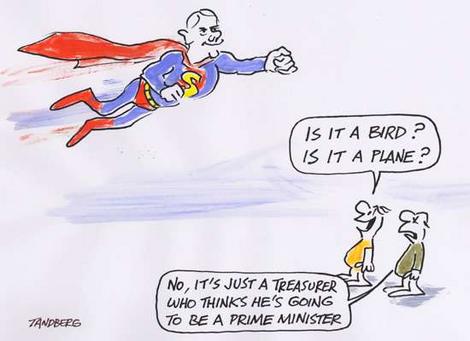
A Cartoon on Costello

Thursday, May 18, 2006

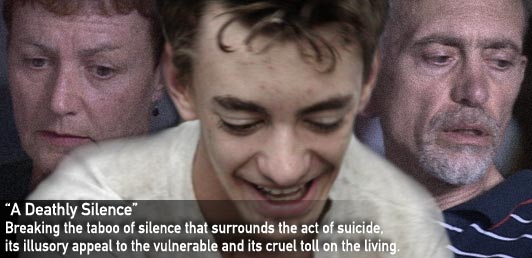
A Deathly Silence


Reporter: Quentin McDermott
Broadcast: 15/05/2006

In the hours before he killed himself in April last year, Campbell Bolton wrote a long note in which he told his family how sorry he was for the pain he was about to cause them. "It fills me with grief when I think of what I have done to you," he wrote.

Nobody doubts he meant it. But, absorbed in his own pain, 17-year-old Campbell could not have comprehended the intensity and the breadth of suffering that he would inflict on others... his parents and brother, veering between sadness and anger, his extended family, friends, his school community, and the anonymous strangers - the emergency and morgue workers who had to handle his shattered body and tell a mother her son was dead.

"He didn’t have any idea of the grief," says Campbell's grandmother. "It's like a ripple in a pool, throwing a stone in a pool."

Now think of hundreds of stones being hurled into a pool, and the ripple effect. When Campbell Bolton died he became one of about 2,000 Australians who deliberately kill themselves each year, a tally that exceeds the huge but humdrum toll of road deaths. On average, one young person, like Campbell, dies by suicide every day. They're statistics to most people - but not to loved ones and the countless others who are touched by suicide.

Four Corners looks for insight into this social catastrophe by exploring the promising life and wasteful death of Campbell Bolton. On the surface nothing was wrong; Campbell came from a high-achieving, middle-class family with no background of drug abuse, violence, psychiatric illness or divorce.

He was a funny, charismatic and extremely clever young man. "Come speech night, he's basically falling over with prizes," a friend says. In Campbell's last months, however, as HSC exams approached, his academic performance slipped dramatically. No one could tell what was wrong.

This Four Corners report does not seek to answer exactly why Campbell ended his life. However it does identify some issues that were occupying him, including hissexuality and an acne problem. It now seems, with benefit of hindsight, that Campbell also had an abstract, intellectual attraction to suicide.

In making this program, Four Corners has sought to avoid glamourising Campbell's death or apportioning blame. Without the courage of Campbell's family, friends and school, the program could not have been made. All who knew him are victims of his death.

"The reason we're doing this program is that there's a deathly silence around suicide," says Campbell's mother Merridy. "Everybody's shocked and everyone says, 'Oh isn't it terrible'... but then the conversation stops."


I watched this program last night and i admit it was slightly disturbing but incrediably insightful. So if you don't have time, please make some and read at least parts of the transcrpt here.

Monday, May 15, 2006

Who Wants to be a Millionaire?

Tussle over images worth their weight in gold
By Dan Silkstone
May 15, 2006
FREED miners Todd Russell and Brant Webb are locked in a fight with mine management over potentially lucrative video footage and photographs taken during their confinement.

The footage, which could be worth hundreds of thousands of dollars as part of a media deal, is being held by the mine's managers despite repeated requests from the two men, sources have told The Age.

Video and still images were taken by the miners with a camera supplied by rescuers and used during the nine-day rescue operation to monitor their well-being and the effect of drilling and blasting on their surrounds.

Both men are trying to negotiate deals with commercial television networks. The hours of footage and dozens of photographs would be extremely valuable but could diminish the value of their story if they were released or sold to a rival network.

The two men are believed to have requested the footage almost immediately after they emerged from the mine on Tuesday.

Mine spokesman Mike Lester said the images were being withheld because a coronial inquiry was under way, not because the company wanted to profit.

"The mine has to work out legally whether or not they can release anything," he said. But Mr Lester confirmed the mine had received offers. "Virtually every media organisation has asked for it," he said. "Not everyone has offered to pay."

Celebrity agent Max Markson, who left Beaconsfield yesterday after failing to persuade the two men to sign up with him, said the footage and pictures were highly sought after.

"It depends how good the quality is but it would give great footage for the TV. People imagine what it's like down there, that's human nature. Now they can see for themselves."

Australian Workers Union secretary Bill Shorten said the pictures and footage should be handed over immediately to the two men. "The images belong to the blokes and if there's anything in that footage that makes the company look bad then the blokes should have it anyway."The spat comes as the battle for the miners' story intensified.

The miners have appointed an agent, Sydney lawyer Sean Anderson, who also represents several Seven Network personalities. Some newspapers reported yesterday that the Seven Network had tabled a $2.75 million bid to each of the miners.

Seven News director Peter Meakin did not deny the mooted figure but said speculation that the pair would feature on Sunrise was wide of the mark.

Speculation that the deal included tie-ins with international media, including The Oprah Winfrey Show and American 60 Minutes, was also inaccurate, Mr Meakin said.

:: :: :: :: :: :: :: :: :: :: :: :: :: :: :: :: :: :: ::

Todd Russell and Brant Webb emerged without a scratch (figuratively of course) and with millions on the horizon. Don't you love that these guys are probably better off after being trapped in a mine for 2 weeks than they were before?

Viva Capitalism!

Monday, May 08, 2006

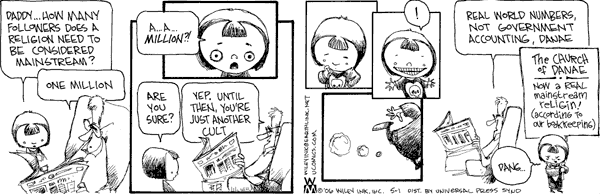
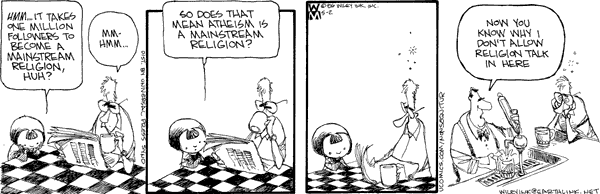
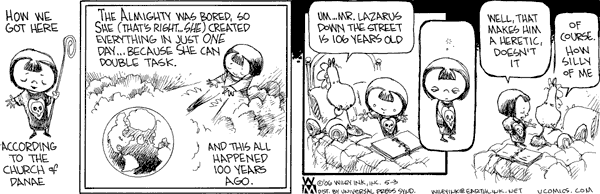
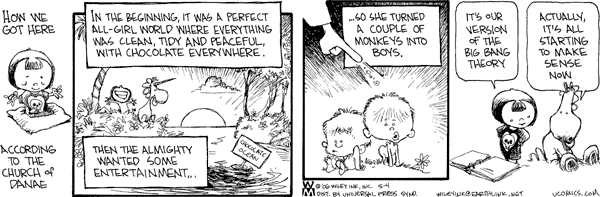
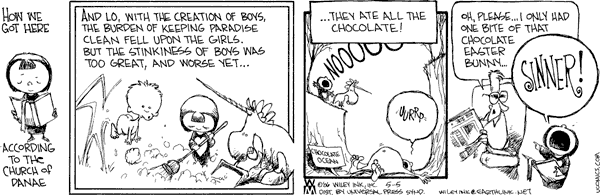
The Origins of Religion...


According to Danae...

Sunday, May 07, 2006

Sunday, April 30, 2006

Met System Racist

By Adam Morton
April 29, 2006

INTERNATIONAL university students are launching an equal opportunity claim against the State Government, arguing rules banning them from travel concession fares are racially discriminatory.

The complaint to Equal Opportunity Commission Victoria will claim foreigners who use public transport pay hundreds of dollars more each year than their domestic classmates due to race.

Campaign spokesman Pradeep Subramaniam said the complaint could lead to Victoria's overseas student population — more than 50,000 last year — taking separate legal action against the state if it was not willing to compromise.

"It's clearly a case of racial discrimination. There's no other basis on which you cannot get concession if you are an undergraduate student," he said.

A daily inner-city Metcard costs $6.10 at full price or $3.20 with a concession. A monthly pass is $49.10 cheaper with a concession card than without.

The discrimination complaint, to be lodged next week, comes at a time of growing disquiet in the international student sector.

Australia's $7.5 billion foreign education market is slowing after years of rapid growth in the face of increased competition from Asia and Europe. Last month 60 overseas students at Central Queensland University's Melbourne campus threatened to go on hunger strike, accusing the university of milking them for upfront fees by examining and failing them on material they were never taught.

About 100 international students from different universities yesterday marched through the city before protesting outside Parliament.

They were inspired by a NSW tribunal last month finding similar travel concession rules in that state breached anti-discrimination laws. NSW and Victoria are the only states that require international students to pay full fare on trains, trams and buses. Victoria also bars postgraduate and part-time students from concessions.

Song Yee Ng, of the National Liaison Committee for International Students, said the fight for equality for foreign students had only just begun. "Even the state governments treat us like cash cows," she said.

Transport Minister Peter Batchelor's spokeswoman, Louise Perry, said overseas students qualified for travel concessions if they were refugees, on exchange programs or held Australian development scholarships.

She said postgraduate and part-time students with low-income health care cards from Centrelink also paid concession rates.

"The State Government is committed to providing public transport concessions to students who are in genuine need," she said.

Ms Perry said it was puzzling that students campaigned over comparatively minor transport fares while staying quiet about massive upfront university fees.

Ms Ng said international students contributed to the economy through GST and payroll tax.

Tuesday, April 25, 2006

Lest we forget the horror and stupidity of war

April 24, 2006

My grandfather, Charles Williams, served at Gallipoli, and later at the Western Front in France. He first met my grandmother after returning home, while fulfilling a personal pledge to find her family and tell of how her brother, a front-line mate, had died. They were married a year later.

A victim of mustard gas, he lived and worked the rest of his life with only one serviceable lung, a condition that, mysteriously, did not prevent him from serving in New Guinea during World War II. He died 60 years after his experience at Gallipoli, in 1975. Only in his final days, drugged with painkillers during the palliative stage of his hospitalisation, did he vividly recount the awfulness of his wartime years with family members, his rambling mind helplessly returning to the nightmarish horrors of his youth. Prior to this period, my grandfather was extremely reticent on the subject of wartime experiences, in spite of the irrepressible curiosity of his grandson. I learned, over time, that it was a subject he did not wish to speak of.

It is with him in mind that I appreciate, and fully endorse, the views of Alan Attwood (Opinion, 22/4) regarding the proper respect for Anzac Day services. Few of us now living, if any, can truly understand what it must have been like for those Australians who landed at Gallipoli in April 1915, or comprehend how sad and painful were the reminiscences of those who survived the senseless chaos of the long months that followed. Few of the multitude of flag-draped "mates" who annually descend upon Gallipoli, realistically, would understand the depth of fellowship engendered between young men constantly living with the threat of imminent death from shellfire or disease.

Attwood reminds us all that the original purpose of Anzac Day services was to set aside a time for veterans to gather and reflect upon their shared experiences, in sombre remembrance of their fallen comrades - not a recurring opportunity for "major event" organisers to entertain and awe members of the general public, or to perpetuate some jingoistic celebration of martial glory and national identity by mythologising a military campaign that was, in actuality, an unmitigated disaster for the invading forces, where more died from dysentery than battle wounds.

Many veterans, my grandfather included, did not appreciate the gradual process through which, over time, their fundamentally private stories were co-opted in the service of a blustering, bellicose patriotism, and, most of all, desired future generations to acknowledge the horror and essential stupidity of war. The great sacrifices their generation made would be wasted if current and future Australians do not share an abhorrence of war, and forever work more towards its reasonable avoidance rather than its glorification. They would want us to reflect upon the human tragedy that World War I was not, as hoped for at the time, the "war to end all wars" - that young people are still called up as cannon fodder whenever politicians tire of resolving differences through diplomacy or have grandiose visions of national destiny.

Lest we forget.
Peter Kartsounis, Footscray

I think we already have.

I hope this battle doesn't take place this year...


'Cause it did in 2005...

Dawn service a time for reflection, not spectacle

By Alan Attwood
April 22, 2006

In the beginning there was an eerie quiet. Before dawn on April 25, 1915, Australian troops packed into boats rowing towards the murky Gallipoli Peninsula were struck by the oppressive stillness. An engineer wrote later they expected, even hoped for, "all hell to be let loose every second, machine-guns, shrapnel, anything but this nerve-racking silence".

The first Anzac Day services, which began within the following decade, made a feature of silence. Many of these events were simple affairs, often open only to veterans; the first official dawn service was conducted at Sydney's Cenotaph in 1927. Services big or small followed a familiar pattern. In the pre-dawn darkness veterans would be ordered to "stand-to". Then came two minutes of silence, broken by a lone bugler.

It was simple; effective; replete with symbolism. So why have we allowed ceremonies to mark the nearest thing we have to an Australian national day to become tacky travesties of what they were meant to be? Modern Anzac Day services are in danger of succumbing to the Major Event syndrome, tricked up with scripts and soundtracks and special effects. Early on Tuesday afternoon, for example, ABC TV will telecast the dawn service from Anzac Cove along with a feature, Spirit Of Place, that, according to one program guide, includes "a musical performance and evocative lighting of the cliffs and gullies, set against images of the Gallipoli landing 91 years ago". What, no spouting fish?

The good news is that this time, unlike last year, there has been no brouhaha about John Farnham singing (or not) at Gallipoli. The bad news is that the swing towards showbiz spectaculars continues unabated. And, of course, there are the souvenirs. An establishment in the ACT has been advertising a "Sands of Gallipoli" plaque - "antique nickel finish metal plate on a wooden base featuring authentic sand collected from the beaches of Gallipoli". So now we know what all those trenching tools were for.

In recent times, there has been controversy about the impact of roadworks and the swelling tourist tide on the former battlefields. One positive aspect of last year's Farnham fuss was that it raised the question of what was, or wasn't, appropriate on the peninsula - even in a concert separate from the official commemorative service. New Zealand's PM put the kybosh on Whispering Jack but made it clear that her home-grown Finn brothers would also not be appropriate.

In the flood of letters and talkback calls debating this issue, two struck me as especially poignant. The first recalled a lone pilgrim to the peninsula starting to sing the Eric Bogle song And the Band Played Waltzing Matilda in the pre-dawn silence then, slowly, thousands participating in an improvised, and very moving, singalong. The second, rejecting the Disneyfication of the site, described the impact of "the grim sadness of the place; its silent melancholy".

The place is its own memorial. It doesn't need slick ceremonies. Nine years ahead of the centenary of the Gallipoli landings - an anniversary to send major event planners into a frenzy - is not too early to suggest that perhaps the peninsula should be given the Uluru treatment. Just as climbing the Rock, once practically compulsory for visitors, is now deemed to be disrespectful, so too could the Gallipoli site benefit from more reverence and simplicity, less sound and lights and PA systems. The story is so strong it does not need artificial aids.

As for Melbourne's official service at the Shrine, I have wished for years that they would do away with the sepulchral, rather banal commentary that precedes the unseen bugler. The immense power of the occasion comes from the gathering of strangers in the gloom; the flickering light of the flame, surrounded by pensive faces; and, above all, the enveloping darkness and silence that recall the conditions of the original heroic and tragically botched military operation.

The day and the way it is remembered has evolved over the past 91 years. The veterans of the first landing have all gone now. Technology has changed everything. No doubt there are computer whizzes around who reckon they could produce a powerful big-screen simulation of the events on Anzac Cove if given half a chance. They should politely be told to keep their memory sticks to themselves. And any major-eventer with plans for massed choirs or Russell Crowe reading some poetry should be reminded that this is a service, not an opening or closing ceremony. Silence can be the most powerful sound; also the hardest to achieve.

Early in the afternoon on Anzac Day there will be a call for silence at the MCG. A huge crowd is expected to witness the annual game between Essendon and Collingwood, which, in its way, has become an important part of the ritual of the day. This doesn't strike me as inappropriate - much less so, certainly, than showbiz presentations or souvenir plaques, complete with pilfered sand. After all, those early Anzacs loved a game of cards or cricket or footy. Any diversion would do. Anything to help them forget what followed that first nerve-stretching silence.

Alan Attwood is a Melbourne writer.

Monday, April 17, 2006

Friday, April 14, 2006

Monday, April 10, 2006

No one can be a leader to all Muslims

By Waleed Aly

April 10, 2006

TO his supporters, Sheikh Taj al-Din al-Hilali is a tireless, selfless, charismatic community worker and scholar who gives hope and guidance to disadvantaged youth, and who bravely risked his life to rescue Australian hostage Douglas Wood from the clutches of terrorists in Iraq. To his opponents, he's the shady imam who doesn't speak English and relied on The Protocols of the Elders of Zion, a Tsarist forgery, to construct wild anti-Semitic conspiracy theories about Jews controlling the world through sodomy. When such an enigma is given the grand sounding title of Mufti of Australia, controversy is inevitable.

So there was a monotonous familiarity to speculation surfacing last week of a move by the Muslim Council of NSW to depose him. The council insists this is not its intention and that it supports al-Hilali, but al-Hilali's backers were out in force anyway, placing abusive calls to the council and warning it would be a huge mistake to undermine him.

So, the fervour in Sydney is undeniable. But the view from Victoria of this undignified scenery is utterly bemusing. For all the considerable public attention he has attracted over the years, and for all the unshakable support we are told he has in Lakemba, al-Hilali remains of more interest to tabloid columnists than to Victorian Muslims. All the voices in the debate are from Sydney. The arguments in defence of al-Hilali focus on his following in Sydney. Elsewhere, the conversation evokes little more than a giant, collective yawn.

The reality is that al-Hilali's controversy has more to do with the murky community politics of south-western Sydney than anything else. That might be fair enough if he was the mufti of Bankstown, but this is being played out on a national stage. Sydney is not yet Australia. It is madness that the rest of the nation's Muslims are involuntarily caught up in this mess.

The problem is not so much al-Hilali as it is the office of the Mufti of Australia. Traditionally, the job of a mufti is to be a source of religious guidance to the community on contemporary religious questions. But the reality in Australia, as in all Western countries, is that religious authority is radically decentralised. People tend to find someone local with whom they feel comfortable, or borrow from a range of religious sources to navigate their own path through the spiritual challenges of contemporary life.

No wonder so many Muslims are regularly bewildered by descriptions of al-Hilali as the "spiritual leader of Australia's 300,000 Muslims" (as though there is one) or "the nation's most senior Islamic cleric" (as though Islam were a church with a formal hierarchy). In truth, no one in Australia, however brilliant, fits these descriptions. Nor is it possible in a Muslim community as dizzyingly diverse as Australia's. In that context, the idea of a national mufti is utterly meaningless, which is why no other Western country has one.

Perhaps unwittingly, al-Hilali's supporters have admitted as much. Take Keysar Trad, who asserted that even if al-Hilali was deposed, this could not "undermine the sheikh's standing in the community". Or al-Hilali himself, who quipped: "A position does not make a man; a man makes a position." The fact is that no one seeks al-Hilali's guidance because he is called the Mufti of Australia. His support base will remain without the title, and his knockers will continue to malign him with it. The only difference it makes is that it falsely projects that Muslims across Australia have a sole religious representative.

With the position itself being such a nonsense, it should be abolished.

Waleed Aly, a Melbourne lawyer, is an executive member of the Islamic Council of Victoria.


This article originally appeared in The Australian.

Damned Politicians

Excerpts of an article from The Age. The full article discusses in further detail the similarities between the three religions of the book.

God of all things

By Andrew Stephens
April 9, 2006

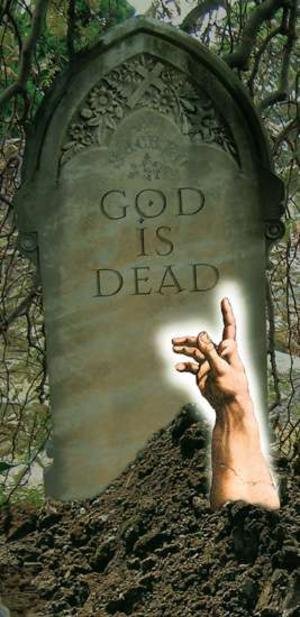
FRIEDRICH NIETZSCHE, the German philosopher, proclaimed in 1882 that God was dead. If that bold claim were true, we must have missed the funeral, because God has been very busy: the century-plus since Nietzsche has been drenched with war and calamity, yet graced with extraordinary developments in our understanding of the universe. Not to mention epic scientific, technological and social change.

[…]

While the faithful are being taught their very similar versions of the "one" God, with a hint of the devil thrown in, it is the intrusion of politics — inter-religious and international — that keeps them from harnessing the spiritual power of their united heritage and ethics. It seems unsurprising, then, that Buddhism, the philosophy-based path that has no god but many deities, is one of the fastest growing faiths in the West; and Hinduism, with its pantheon of beautifully coloured gods, no prophet, no founder and no creed, remains the third-biggest religion in the world.

[…]

With such common ground on God and evil among the major monotheistic religions, surely the tolerant co-existence that exists to a large extent can be furthered, with the same open-minded and searching quality evident in the scientific community, who are also trying to understand our existence?

Christianity, Islam and Judaism — whatever their deep and complex distinctions — each propound one unique God who made the universe. Each believes that the faithful should do God's will and live by certain rules, that a holy way of life should include acts of loving kindness, prayer, study of their holy text, and certain rituals. And each proposes some idea of heaven or an afterlife.

Contemporary life is difficult. In less developed nations it is the basic struggle to survive that makes life hard. In developed countries it is the struggle to find and practise basic values under the welter of rampant consumerism, galloping technological change and the incessant pressure of material concerns: acquiring money, possessions, status, beauty. Yet we crave meaning and spiritual happiness. In the West, writes Buddhist Sogyal Rinpoche, it is important not to get caught in a "shopping mentality" with religion, but to follow one tradition with all your heart yet remain open and respectful to all the other religions.

[…]

The dearth of spiritual values we can attribute to our political leaders — honesty, justice, compassion, acceptance — is glaring. Author Mark Juergensmeyer says that when governments start to embrace moral values associated with religion, then a level of mutual interfaith trust and respect is possible between religions.

Looking beyond dogma to the shared spiritual goals that are the touchstones of religion is something Melbourne theologian and ethicist Rufus Black endorses. He says that one of the main ways of encouraging mutual tolerance is to move from an age of conversion to an age of conversation.

"The shift that we have to make in our world is to end this attempt to convert each other and to begin much more profoundly with conversations of much deeper mutual understanding. For that to happen we need to address the underlying social, political and economic circumstances that make fundamentalism attractive both in theIslamic and non-Islamic world."

This also involves getting those in the three big religions with a more tolerant vision to speak much more strongly, and for the media to stop "grossly simplifying" the world of religion. "The more subtle, complex ways of talking about God don't get much of an airing."

People such as Constant Mews, director of the Centre for Studies in Religion and Theology at Monash University, are working towards interfaith understanding. His own path in Christianity has been influenced by his exposure to Hinduism and Buddhism and today he is running a seminar on how those two faiths inform each other on ideas about the human mind and emotions.

More broadly, he says the three big one-God faiths need to go beyond their own narrow focus, beyond "mere toleration", and start understanding what each has to say about the oneness of God and their common goals.

Indeed, Muhammad Kamal is keen to stress that, for much of history, the three big religions have co-operated harmoniously. "But when you think of religion as a political institution and reduce the kingdom of God into that political institution, then the differences arise.

Today, when some people — mainly in the media — focus on the differences rather than similarities, things become difficult. Arabs and Jews lived in Palestine or Israel for a long time peacefully. Politics created divisions and differences. The Middle East has been the centre of three major monotheistic religions and the followers of these religions lived for centuries together. In small neighbourhoods, Christians, Muslims and Jews lived together, their children played together."

He pauses thoughtfully.

"People talk about the clash of civilisations but don't realise that we are deeply connected. Those who try to reduce God into a political institution reduce God from the absolute position into a human position. For me, this is the end of God."


:: :: :: :: :: :: :: :: :: :: :: :: :: :: :: :: :: :: ::

Why can't we all just get along?

Damned politicians.

Friday, April 07, 2006

Revealed: The Gospel of Judas


By Linda Morris
April 7, 2006 - 8:08AM

A 1700-year-old papyrus manuscript suggests history has misjudged the greatest villain of Christianity: Judas was under orders when he betrayed Jesus.

The only known surviving copy of the lost gospel of Judas portrays the treacherous disciple as a loyal deputy acting at the behest of his leader.

In fact, Judas sold Jesus out as an act of obedience not treachery, thereby fulfilling his theological destiny. Key passages from the third or fourth century Coptic manuscript were released by its publisher, the National Geographic Society, last night, a week before Easter, the holiest time of the Christian calendar.

The society, which is rumoured to have purchased publishing rights for more than $1 million, plans magazine articles, television specials and book deals amid concerns about the ethics of ancient acquisitions.

The society's panel of scholars has submitted the document to radiocarbon dating, ink analysis and spectral imaging and has declared it authentic.

The gospel of Judas is believed to be the work of gnostic Christians, a stream of Christian thinking declared heretical by early church fathers. It is a companion text to ancient scriptures unearthed in 1945, which have formed the basis of some assertions in Dan Brown's controversial bestseller The Da Vinci Code.

Australian biblical scholars said the document would be likely to provide a window on early Christianity, but did not threaten Christian teachings because while it was old, it did not date to the time of the Bible's Gospels.

"The text bears witness that to some people Judas was a misunderstood character," said Dr Malcolm Choat, a specialist in early Christianity at Macquarie University. "It fills in the picture but it doesn't make the picture."

But the Coptic Orthodox Church dismissed the document as "non-Christian babbling resulting from a group of people trying to create a false 'amalgam' between the Greek mythology and Far East religions with Christianity They were written by a group of people who were aliens to the main Christian stream of the early Christianity," the church's theological leader, Metropolitan Bishoy, said.

"These texts are neither reliable nor accurate Christian texts, as they are historically and logically alien to the main Christian thinking and philosophy of the early and present Christians."

The Judas gospel is a third or fourth century Coptic manuscript discovered in the desert near El Minya, Egypt, in the 1970s. It was sold to a dealer in illicit antiquities and languished in a safe deposit box in the US before falling into the hands of a Swiss foundation.

The Bible says Judas betrayed Jesus to the Romans for a purse of 30 pieces of silver in the Garden of Gethsemane. He later hung himself.

According to limited extracts of the gospel of Judas offered to the Herald, Jesus explains Judas his role in the crucifixion: "You will exceed all of them. For you will sacrifice the man that clothes me."

In other key passages released to the public, Jesus confides: "Step away from the others and I shall tell you the mysteries of the kingdom. It is possible for you to reach it, but you will grieve a great deal."

For his role Judas would be despised by the other disciples: "You will be cursed by the other generations and you will come to rule them." The gospel ends: "They [the arresting party] approached Judas and said to him. 'What are you doing? You are Jesus's disciple'. Judas answered them as they wished. And he received some money and handed over to him.

As well as the gospel of Judas, the newly discovered 66-page document also contained a text titled James, a letter of Peter to Philip, and a fragment of a fourth text scholars are provisionally calling Book of Allogenes.

Flawed media cover widens a great divide

By Michael Gawenda
April 3, 2006

THE great Israeli writer Amos Oz once wrote that while knowing history is probably a good thing, knowing too much is a form of tyranny. In the bitter conflict between Jews and Arabs, each side has known too much of its own history and nothing of the history of the other. This must mean that the national narrative of each side must be seriously flawed. Indeed, what it means in this conflict is that each side denies almost totally the historic narrative of the other.

This is not an original insight, which is not surprising given that the dispute between Israelis and Palestinians has been subjected to more analysis and scrutiny than perhaps any other conflict in the past century.

It is a conflict burdened by too many insights, too many opinions, too many facts. Around 400 extra journalists came to Israel to cover last week's elections, joining close to 600 Jerusalem-based reporters who regularly report on the Middle East for newspapers and television around the world. That's a lot of journalists in a country the size of a half a dozen Melbourne outer suburbs.

It would be fair to say that a significant proportion of us journalists who flew into Jerusalem in the past week or so did not come with the burden of too much history weighing heavily on our shoulders. This is not meant as a criticism. We journalists are not historians but rather imperfect and often bewildered people trying to do the impossible: make sense of a conflict that is suffused with great passion and great hatred. And bitterly disputed competing historic narratives.

The best journalists acknowledge their limitations and, where possible, make explicit their prejudices. This means making as clear as possible the paradigm through which they are reporting the conflict. The best journalists resist the enormous pressure on them in a world of media fragmentation and fierce competition to be bold and to "know what's happening". The best journalists admit to doubt and at times, total bewilderment. They tread warily.

It is hard to tread warily in a world of 24-hour cable news services. One day in Ramallah, an American cable network crew did a two-minute report from the Palestinian Legislative Council building to which their "fixer" had brought them and where he had lined up a couple of Hamas spokesmen.

Not all journalists who report from the West Bank or Gaza use fixers, mostly Arab Israelis who know their way around, have contacts in the various Palestinian factions and can line up people for interviews. But most visiting journalists, especially TV reporters — and a fair number of Jerusalem-based correspondents — use fixers.

It is impossible to say just how much this affects the reporting of the Palestinians, but that it does have an effect is beyond doubt. Given the language barriers and the chaos and tension of occupation, the feuding militias and the presence of armed gangs, it is inevitable that the fixer will, to a greater or less extent, be our eyes and ears.

Having met the spokesmen, the cameras rolled and the journalist asked a question: what would be your preferred outcome in the Israeli elections? This is not a terrible question, and it is certainly nowhere near as silly, for instance, as asking a Palestinian who has been stuck at a military checkpoint for hours because of a security alert, how he or she feels.

But it is a question that will inevitably elicit a predictable response and that will allow the journalist to state on camera, with some authority, that the new Hamas Government has no interest in the election outcome, a bold statement, the boldness of which is simply not justified.

Amos Oz, who helped found the Peace Now movement in 1977, also once said that the tragedy of the conflict between Israelis and Palestinians is that it involves two peoples with equally valid national aspirations, which is another way of saying that each of their historical narratives have moral and ethical force.

When it comes to reporting this conflict, not only do a lot of journalists know little about these narratives, but for obvious and non-malign reasons, they quickly conclude that the Palestinian story, whatever the history, is one that has led them to great suffering and dispossession, which means the Israeli story must be about conquest and occupation of stolen land.

The paradigm is one of victims and victimisers, helpless and hopeless Palestinians on the one hand and brutal occupiers and oppressors on the other. One narrative is true and tragic and one narrative is false, an example of the colonialist's lies and propaganda.

One result of seeing the conflict through this paradigm is that by reducing Palestinians to victims, their leaders are reduced to victims as well and are excused from taking any responsibility for their political failings, for the corruption that they encouraged and from which they personally benefited, from taking responsibility for the opportunities they passed up to improve the lives of their long-suffering people and perhaps even give the Palestinians the state that is so clearly their right.

Why is it that for all the hundreds of journalists covering the conflict, there was no great attempt to expose the massive corruption of Fatah under Yasser Arafat, which most journalists knew about and which led to the squandering of billions of aid dollars that could have been spent, should have been spent, to give the Palestinians an economic future?

The answer seems obvious.

United States correspondent Michael Gawenda is in Israel to report on the election.